
Views: 0 Author: Site Editor Publish Time: 2026-10-01 Origin: Site


When securing an architectural space, hardware dimensions dictate both function and aesthetic appeal. Choosing an improperly sized bolt can easily ruin a beautifully crafted entryway before you even drive the first screw. Selecting the incorrect length for a door bolt remains a frequent failure point in carpentry. This misstep quickly compromises door security, damages delicate door stiles, and necessitates costly, frustrating rework. Whether retrofitting historical hardware or securing a brand-new build, you must evaluate hardware dimensions carefully. You need to match the bolt's physical footprint exactly to your door's strict structural constraints. Here, we provide a transparent, specification-driven framework for your project. You will discover how to evaluate and select the precise length for brass door hardware. We will base these decisions directly on mechanical requirements and your specific installation environment.
You must understand the distinct measurements of hardware components before modifying your door. A standard bolt assembly consists of three primary dimensions. The "Overall Length" refers to the main body containing the sliding mechanism. The "Throw Length" represents the actual distance the internal rod extends past the body. The "Keeper" or "Strike" is the separate receiving plate mounted to your door frame.
Overall length determines how much physical space the hardware occupies on the door face. Throw length dictates functional security. If you buy a massive ten-inch bolt body, it provides no extra security if the throw only extends half an inch. You need a throw long enough to securely engage the keeper across any existing gaps.
The standard setback rule is your next critical metric. You cannot mount hardware flush against the absolute edge of a wooden door. Driving screws too close to the edge causes the wood grain to split. Industry standards require a minimum setback of 1/2 inch to 3/4 inch from the door edge. This safety margin ensures the mounting screws bite into solid, structurally sound wood. It provides the holding power necessary to resist forced entry.
Clearance gaps also dictate your hardware sizing. You must measure the resting distance between the closed door face and the door jamb. The bolt must bridge this empty space before it even reaches the keeper. If your frame features decorative molding, the gap may be highly irregular. Measure this gap meticulously. Ensure your selected throw length exceeds this gap while still leaving enough rod to engage the keeper fully. Otherwise, the bolt will bind or fail to lock securely.
Always measure your hardware footprint using calipers or a rigid metal tape measure. Cloth tapes stretch over time and provide inaccurate readings. Record your clearance gaps at both the top and bottom of the door. Old houses often settle, meaning the gap might measure 1/4 inch at the floor but 5/8 inch near the header.
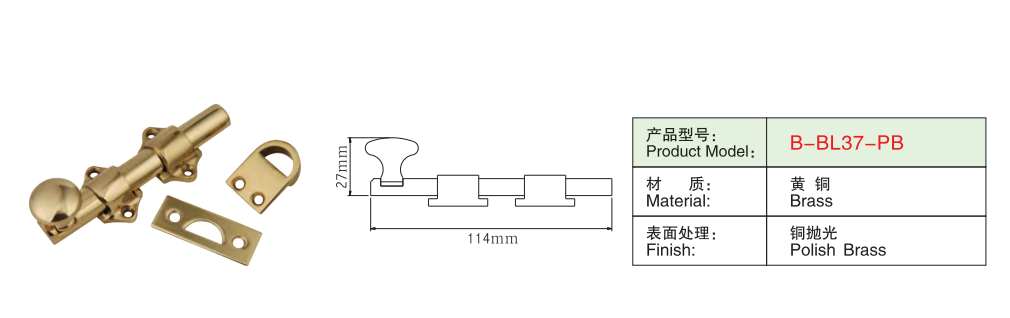
The vertical stile serves as the primary structural frame of your door. This solid piece of wood runs vertically along the hinged and latching edges. It is the ultimate constraint for surface-mounted Brass Door Bolts. If you try to mount a bolt longer than the stile width, the hardware will overlap onto the central door panel. Central panels are usually thin, floating inserts. They lack the thickness required to hold mounting screws safely.
Proportional sizing prevents severe structural damage. A bolt must fit entirely within the flat surface of the stile, accounting for the required edge setback. Installing a 6-inch bolt onto a narrow 4-inch stile simply does not work. The back end of the bolt will hang over the molded profile. This looks terrible and eliminates mechanical support for the rear mounting screws.
When dealing with narrow stiles, you must adapt your hardware strategy. French doors and historical entryways often feature stiles measuring less than 3 inches wide. In these cases, horizontal installation becomes impossible. You should switch to a vertical mounting configuration. Install the bolts at the very top or bottom of the door, shooting the throw upward into the header or downward into the floor. This allows you to use longer, more secure bolts without violating the horizontal space constraints of a narrow stile.
Below is a quick reference guide matching standard stile widths to safe maximum bolt lengths. These calculations assume a standard 1/2-inch edge setback.
| Door Stile Width | Edge Setback Required | Max Safe Overall Bolt Length |
|---|---|---|
| 3.0 inches (Narrow) | 0.5 inch | 2.0 - 2.5 inches (or mount vertically) |
| 4.0 inches (Standard) | 0.5 inch | 3.0 - 3.5 inches |
| 5.0 inches (Wide) | 0.5 inch | 4.0 - 4.5 inches |
| 6.0+ inches (Oversized) | 0.5 inch | 5.0+ inches |
Your sizing methodology changes drastically depending on the style of hardware you choose. Surface-mounted hardware requires external aesthetic considerations. Concealed hardware demands precise internal routing depths.
When selecting a surface-mounted sliding door bolt, you evaluate visual proportion and external space. The hardware remains completely visible. It needs to align beautifully with existing molding, trim, and escutcheon plates. You must ensure the sliding knob has enough clearance to move freely. If you mount a bulky sliding bolt too close to an overhanging door jamb, you might trap your knuckles every time you lock the door.
Concealed or flush-mounted bolts introduce stricter engineering constraints. You install these units directly into the edge of the door. The primary evaluation criteria shift to internal routing depth and overall door thickness. You must hollow out a cavity inside the door edge. Industry standard door thickness ranges from 1 3/8 inches to 1 3/4 inches.
If you route a deep cavity into a thin door, you destroy its structural integrity. The door edge will splinter under minimal pressure. Therefore, sizing a flush bolt requires a careful sequence of checks:
You must also coordinate your sizing with the primary latching mechanism. Secondary security hardware must never physically interfere with your main lock. If you install a long flush bolt directly above a mortise lock, the internal cavities might collide. Ensure you leave a solid block of undisturbed wood between the primary door latch bolt and your secondary security hardware. This separation preserves the overall strength of the stile.
The throw length serves as your primary defense against forced entry. Selecting the correct throw requires calculating the distance it must cross to reach safety. You start by analyzing the gap between the closed door and the frame.
Modern pre-hung doors usually feature a tight, standard tolerance gap of about 1/8 inch. Historical frames often warp, creating irregular gaps exceeding 1/2 inch. You must add the gap distance to the depth of the keeper to find your minimum throw requirement. If your gap is 1/2 inch, and the keeper requires 1/2 inch of rod for a secure lock, your absolute minimum throw length is 1 inch. Anything shorter will fail to lock or pop open under a heavy breeze.
Load distribution explains why a longer throw necessitates a proportionately longer bolt body. When force pushes against a locked door, the protruding throw acts as a lever. It transfers massive kinetic energy back into the bolt housing. If you have a long 2-inch throw but only a tiny 2-inch body holding it to the door, the mechanical leverage will rip the screws right out of the wood. A longer body distributes this extreme pressure across a wider surface area and utilizes more mounting screws.
You must also carefully match the throw length to the depth of the mortised strike plate. The rod must extend fully to engage its internal locking detent. If your strike plate cavity is too shallow, the bolt will "bottom out" against the wood frame before the mechanism locks into place. You will need to chisel the frame cavity deeper to accommodate a longer throw.
Solid brass provides excellent durability and a premium feel, but it introduces distinct installation risks. High-quality brass hardware carries significant weight. A heavy, oversized brass door bolt demands a strong foundation. You cannot safely install a massive 8-inch solid brass unit onto a lightweight, hollow-core interior door. The sheer gravity of the metal will eventually pull the short mounting screws out of the thin veneer. Longer hardware requires solid-core or solid wood doors to anchor the fasteners securely.
Retrofitting introduces severe alignment challenges. When replacing old hardware, you usually face a scarred door surface. You will find pre-existing screw holes, faded paint lines, and old mortise cutouts. Matching a new bolt length precisely to old screw holes is nearly impossible. Modern manufacturing dimensions rarely align with antique hardware footprints.
We recommend a specific mitigation strategy for retrofits. Opt for a slightly oversized bolt body. If your old hardware was 4 inches long, buy a 4.5-inch replacement. The larger footprint acts as an escutcheon, covering the unsightly gouges, faded paint, and old screw holes left behind. However, before sizing up, you must re-verify your stile width. Ensure the newly upsized length will not overhang the stile edge or interfere with the internal door framing.
Many installers fail to pre-drill pilot holes for heavy brass screws. Brass is a relatively soft metal compared to hardened steel. If you force a brass screw into dense oak or mahogany without a pilot hole, the screw head will strip or snap off entirely. Always drill precise pilot holes and lubricate the screw threads with beeswax before final installation.
Selecting the correct hardware dimensions requires a structured, logical sequence. You must first measure the available horizontal stile width to establish your absolute maximum footprint. Next, measure the resting gap between the door and the frame to determine your required throw extension. Only after securing these two measurements should you select the final overall bolt length.
By mapping your physical constraints first, you eliminate the risk of purchasing incompatible hardware. You protect your door from structural splintering and ensure the locking mechanism can withstand forced entry.
Before you finalize your hardware schedule or place an order, take immediate action. Grab a precise tape measure or a set of digital calipers. Walk to your door, measure the exact stile width, and record the door-to-frame gap. Documenting these two numbers today will save you hours of frustrating modifications tomorrow.
A: There is no single universal standard. While 4-inch and 6-inch models remain highly common, the ideal size heavily depends on the application. Primary exterior doors usually demand larger 6-inch to 8-inch bolts for enhanced structural security. Smaller 2-inch to 3-inch models are standard for lightweight interior applications, cabinets, and windows.
A: Close the door fully and measure the empty gap between the door edge and the frame. Next, add the depth required for the rod to securely engage the keeper or strike plate. Your chosen hardware must feature a throw length that slightly exceeds this total combined measurement.
A: Surface-mounted sliding units generally cannot be cut. Modifying the exterior housing usually destroys the internal sliding mechanism and ruins the decorative finish. However, if you are using an internal flush mount system, the hidden internal rods can sometimes be trimmed down to fit custom door heights.
A: Yes, but in two different ways. The body length dictates mounting strength because a longer body uses more screws, distributing impact force safely. The throw length dictates pry-resistance. A longer throw extending deep into the door frame makes it significantly harder for an intruder to pry the door open.